
Pascagoula City Directory Collections by Era
Where a Pascagoula volume sits depends heavily on its year. The historic directories are scattered across several repositories. USM holds the main R. L. Polk Pascagoula and Moss Point run. Its telephone and cross-reference volumes carry the address trail into later decades. The Singing River Genealogy and Local History Library rounds out the shelf with local books, cemetery material, family histories, census indexes, and other context. Treat every volume as a dated publication. A single edition can show an address association, a telephone listing, or a street guide entry for that year alone. It never establishes where anyone lives now.
| Historical collection | Documented span | Holding route | How to consult it |
|---|---|---|---|
| Polk’s Pascagoula/Moss Point directories | 1957; 1959–60; 1962–63; 1965–69; 1971–78; 1987; 1989 | USM and related library holdings | Special-collections or library access; alphabetical, street, reverse-phone, and profile sections |
| Pascagoula telephone books | 1962–2014 | USM | Fifty-eight documented volumes; capture volume year and page |
| Telephone cross-reference collection | 1953–2014 | USM | Fifty documented volumes; useful for changed numbers, exchanges, and spellings |
| Additional Polk’s titles | 1975, 1976, 1978, 1982, 1986–88, 1990–93, 1996 | Harrison County Library guide | Neighboring-system finding aid for gap years |
| Genealogy and local-history collection | Title years vary | JGRLS Singing River library | Ask staff for the title, date, call number, and scan policy |
No collection covers every year. Missing volumes are simply normal. Bridge a gap with the nearest directory or phone book. A dated newspaper notice, tax roll, or map can work too. Label the gap instead of guessing. Mississippi State University lists Polk's Pascagoula and Moss Point volumes for 1966, 1969, and 1970. That helps when another shelf skips those years.
Note: Publication years show when a directory was issued. They do not prove continuous residence between one volume and the next.
Pascagoula Historical Research at Singing River
The Jackson-George Regional Library System holds roughly 5,000 genealogy volumes. That shelf spans family histories, directories, cemetery records, land material, death records, and local histories. Its Singing River Genealogy and Local History Library sits at 3214 Pascagoula Street. The local-history telephone is 228-769-3078. The Pascagoula Public Library shares that address. It answers at 228-769-3060. Call or visit with something specific. Name a year, a street, a surname spelling, or a collection title. Asking staff to track down every person with a name rarely works.
Online routes help before a visit. The Mississippi Digital Library's JGRLS collections cover Jackson County records. They identify school records and the Joann Anderson Slides. The USM city-directory guide explains the Polk collection views. Some volumes live only on a shelf. Call or email first about access and copying. County Archives, USM, and MDAH are stronger fallbacks in person. A county office request or fax works for one defined historical record. It is no substitute for browsing a directory shelf.
The local collection earns its keep in one common case. A county index may name a person but drop the original context. The library can also tie a directory entry to school, cemetery, or county-history material. Preserve the library, title, edition, and page, with any note attached. Library and society materials are finding aids. A county custodian still keeps responsibility for government records. A directory year may be missing entirely. The practical fallback is the nearest volume. Pair it with a newspaper, tax, land, cemetery, or school source that carries its own date.
How Pascagoula City Directory Entries Read
USM describes four views inside its Polk volumes: a business-classified section, an alphabetical list, a householder list arranged by street or avenue, and a reverse telephone directory. Each view answers a different question. Start with the alphabetical listing for a name. The street guide shows who was associated with a number in that edition. Read the title page and abbreviation key first. A status note or short abbreviation can change the meaning of an entry.
| Exact name | Copy initials, spelling, and punctuation as printed, then record the directory year and page. |
|---|---|
| Address | Capture the house number and street exactly; compare it later with the street guide rather than modernizing it first. |
| Telephone | Note the number or exchange when printed. The telephone books and cross-reference run may supply another dated lead. |
| Occupation or status note | Record only what the volume prints. It can distinguish similarly named people but is not proof beyond that edition. |
| Street-guide context | Save the street name, number, householder, cross street or exchange, and the page that shows them. |
- Criss-cross directory
- A street-order listing that groups entries by address rather than by surname. Later directory and telephone material may offer this kind of cross-reference.
- Householder index
- A list arranged around the person identified with a household or address in that particular publication.
- Abbreviation key
- The volume’s explanation of its short forms. Photograph or note it before interpreting a status or address mark.
A directory abbreviation is not an identity claim. Match the name, year, address, and source type against a second dated record before drawing a family-history conclusion.
Pascagoula Telephone Cross-References
The USM telephone-book collection gives Pascagoula an unusually long address and exchange trail. The main telephone-book run spans 1962 through 2014. The cross-reference collection reaches back to 1953. Use this with a common surname. Compare an address, number, or exchange in adjacent volumes. Two similar entries are not automatically the same person. A changed number is a lead to test, not proof of a move.
For a former address, start with the street-arranged entry. Then check the alphabetical or telephone material for the same edition. A current address question belongs with the county map and land-record channels. The Pascagoula street directory route follows that modern, address-based trail.
Pascagoula Archive Clues for Old Directories
Independent dating strengthens any old Pascagoula listing. The Pascagoula Democrat-Star in Chronicling America covers 1878 through 1920 and reaches well beyond newsprint. Estate notices, civic reports, obituaries, addresses, and public-event notices all surface there. A surname alone works; a surname paired with a street, institution, or date works better. Jackson County Archives carries local newspapers through 1929 in hard copy and microfilm. It also holds land rolls, tax receipts, Board minutes, and Chancery cases.
The second county courthouse burned in 1875. That fire marks a hard boundary for early digging. Most archival holdings run 1875 forward. MDAH's Jackson Court House District files cover earlier land claims from 1820 to 1847. The Jackson County cemetery compilation adds vital data for 1813 through 1908 across more than 250 cemeteries. Check any cemetery transcription against the original marker or a custodian record when the conclusion matters.
Pascagoula Addresses on Historic Maps
Old addresses live on maps, not just in print. The 1918 Pascagoula Sanborn map spans fourteen sheets. The sheets show streets, blocks, building footprints, business labels, public facilities, and address ranges. It gives place context rather than a private-resident list. Pair the sheet number and map date with a directory year. That way an old street entry never gets forced into a modern grid.
Four named historic districts also shape the city. They are Krebsville, Orange Avenue, Scranton, and the International Shipbuilding Company district. The Historic Preservation Commission and the MDAH historic-property search add district and resource detail. Those boundaries make fine local-history filters. But they are not interchangeable with ZIPs, wards, precincts, or parcel lines.
Trace a Pascagoula City Directory Household
Family-history research works best as a dated sequence. Begin with one confirmed listing. Then move through nearby editions. Keep each address spelled exactly as the publisher printed it. When a name drops out of an old directory, the reason stays hidden. A move, a changed listing practice, a death, an omission, or a missing volume could all explain the gap.
- Locate the first known name in an alphabetical or street listing and record the year, page, address, telephone detail, and every printed abbreviation.
- Check the nearest earlier and later documented volumes, including telephone cross-references, for spelling changes, address changes, or a matching number.
- Use the street guide or criss-cross listing from the same edition to keep the address association separate from the name listing.
- Pair each dated result with the applicable census-era or county source, then write down where the dates do not meet.
- Use a newspaper, cemetery source, Chancery file, or Archives land roll as a second record for a move, estate clue, or family connection.
What if a street number no longer matches? Hold on to the old spelling, the lot or block reference, and any landmark. Keep the map sheet, too, before calling the address absent. Pascagoula's street layout and transportation history shifted over the decades. Older records often lean on a landmark or a historic place name. They may not use a modern address at all.
Pascagoula City Directory Context in Civic Files
For current civic context, the Pascagoula Agenda Center is a separate source. It carries date, term, category, and year controls. Packets from the City Council, Historic Preservation Commission, Redevelopment Authority, Planning Board, and Recreation Commission can place a person, property, organization, or district action in a dated public setting. Save the packet date and page. One caution: a name in a meeting record does not prove a residential tie. The Agenda Center filters display the controls available for civic research. These include date-range, keyword, category, year-folder, and downloadable-packet controls.
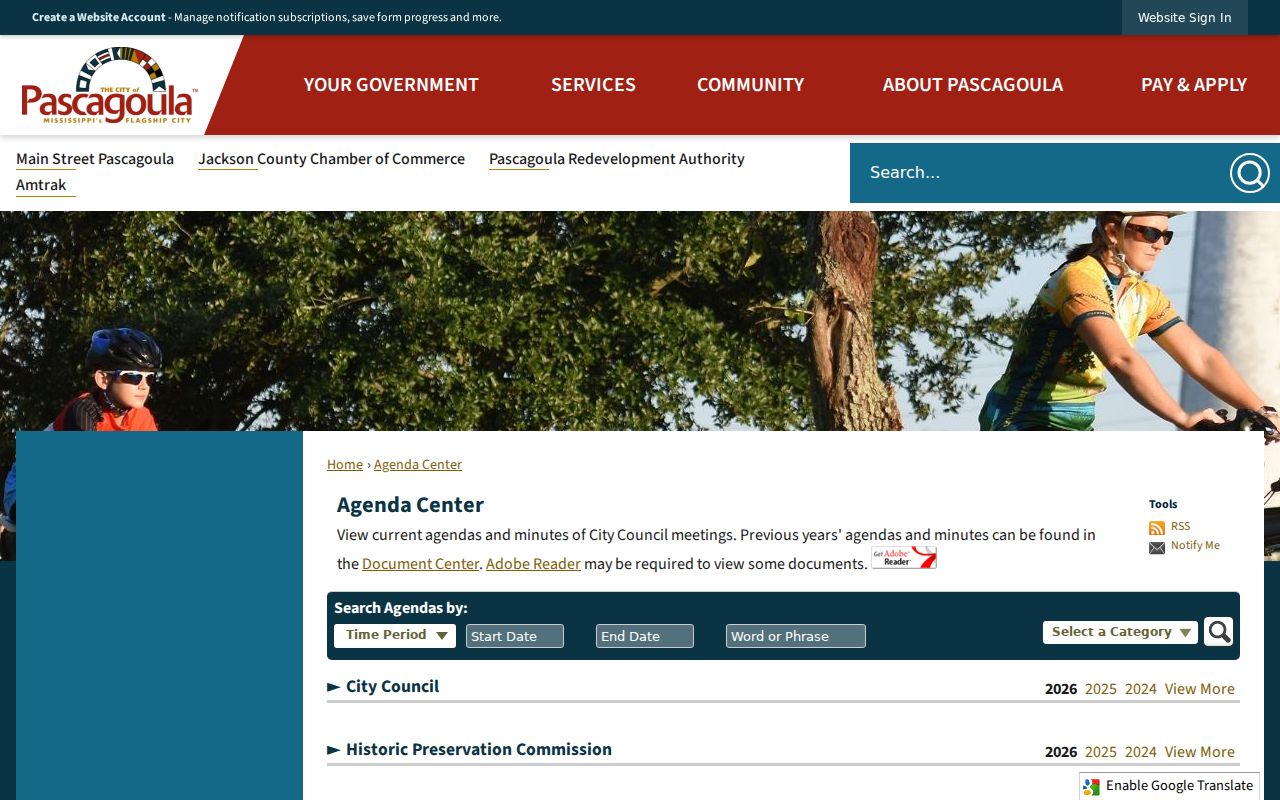
Use the filters to find a street, historic district, or known public action. Then compare its date with the historical listing. The packet offers civic context, not a directory entry. Note: Keep a dated city packet's board category and action attached, so it is never mistaken for a private-address record.